05. Continuous Training and Development

One-time safety orientation is insufficient in the face of changing project risks, legislation, and developing technology, therefore ongoing training and development are essential to maintaining a resilient health and safety culture in Sri Lanka's construction sector. Therefore, regular, planned training that stays up with industrial advancements must be established via HRM methods. In a study of large-scale building projects in Sri Lanka, for instance, Kumara (2023) discovered that the current safety training is insufficient and that much more frequent sessions—covering topics like first-aid, fire, and working at heights—are necessary to create an accident-free workplace. Furthermore, more creative strategies are becoming popular. For example, a recent comparison research by Hewagarusinghe and Sridarran (2024) showed that, in comparison to traditional methods, virtual reality (VR)-based training greatly increases workers' safety awareness and retention. According to Amarakoon (2025), informal, on-the-job techniques like toolbox talks and peer mentorship have demonstrated significant efficacy in increasing safety awareness among Sri Lankan construction workers in addition to official training. The need of context-specific, ongoing education in the field is further highlighted by the launch of a professionally created health and safety instruction manual designed especially for Sri Lankan construction workers. HRM makes sure that workers stay current on safety procedures, are better prepared to handle emerging risks, and actively participate in a culture of continuous safety improvement by combining planned, periodic formal training with experiential and informal learning.
Components of Effective Training Programs:
- Regular Safety Workshops
Frequent safety workshops are an essential way to maintain and strengthen a proactive safety culture, particularly in high-risk sectors like construction. These seminars, which should ideally take place every month or every three months, provide organized chances for group education, introspection, and ongoing development. Organizing such workshops inside an HRM framework allows management to have meaningful conversations regarding recent events, near misses, new dangers, and safety process improvements with employees, supervisors, and safety officers. Workshops are more effective than passive lecture-based training at fostering a deeper grasp of safety principles, encouraging behavioral change, and enhancing hazard awareness through interactive formats like case studies, group discussions, role-plays, and practical demonstrations. The importance of these sessions is supported by empirical data: systematic evaluations demonstrate that regular and ongoing training interventions, backed by management commitment, greatly improve safety culture and reduce accidents. HRM-driven workshops can also assist close the gap found in local research in the Sri Lankan construction context: The necessity for more frequent, varied, and context-specific safety instruction is highlighted by Kumara's (2023) demonstration that existing training is frequently inadequate in major construction projects. Furthermore, according to Amarakoon's (2025) study, informal forms that are frequently employed in Sri Lanka—like toolbox discussions and peer mentoring—are very successful in repeating the themes presented in workshops.
Workshops can also be used to present new training manuals or approaches that are adapted to local requirements. For instance, Kesavan and Alagiyawanna (2023) created a professional training manual especially for Sri Lankan construction workers, which could be incorporated into workshop curricula to increase relevance and engagement. Organizations may sustain the momentum of safety training and create a learning-oriented, reflective, and participatory safety culture where employees actively participate in risk management and continuous improvement by integrating regular safety seminars into HRM practices.
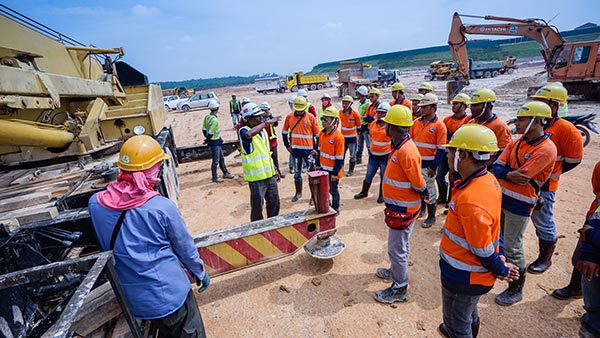
- On-the-Job Training
On-the-job training (OJT) is one of the best methods for enhancing workers' safety competency within the larger objective of enhancing health and safety in Sri Lanka's construction sector from an HRM standpoint. Because construction work is very practical and task-specific, on-the-job training (OJT) allows workers to learn safety practices in a real-world setting with actual equipment, circumstances, and risks. Compared to classroom education alone, this real-time, supervised learning significantly increases retention, promotes safe work practices, and develops danger recognition skills (Zhou et al., 2023). OJT solves a crucial training vacuum in Sri Lanka's construction industry by offering easily accessible, practical assistance that is customized to the particular activities workers undertake. These issues include skill shortages, informal labor recruiting, and varying literacy levels (Kumara, 2023).
According to research conducted on Sri Lankan construction sites, informal, hands-on techniques like supervisor demonstrations, shadowing seasoned workers, and peer mentoring greatly improve safety behavior, especially in settings where formal training is sporadic or nonexistent (Amarakoon, 2025). When combined with regular monitoring and encouraging HRM policies, frequent site-based training also lowers risky behaviors and accident rates, according to international research (El-Safty et al., 2021). HRM guarantees that safety becomes a routine part of work processes rather than an external need by integrating OJT into everyday site operations. This promotes a more skilled, self-assured, and safety-conscious workforce throughout Sri Lanka's construction sector.
- Feedback Mechanisms
In an HRM framework where communication, learning, and corrective action must be methodically managed, effective feedback systems are crucial for bolstering safety culture and continual development in the construction industry. Feedback enables employees, managers, and safety officers to communicate in real time about hazardous situations, near-misses, behavioral abnormalities, and chances for improvement in construction settings, where dangers are always changing. According to research, organized feedback loops greatly improve safety performance by facilitating prompt remedial action, rewarding positive behavior, and raising employee involvement in safety procedures (Feng et al., 2023). HRM-driven feedback mechanisms, such as anonymous reporting channels, digital safety apps, toolbox meeting discussions, and daily debriefs, help overcome the fear of blame and promote honest reporting in Sri Lanka's construction industry, where communication gaps and hierarchical barriers frequently restrict upward reporting (Perera & Dissanayake, 2020). Research on local initiatives shows that when managers give constructive, encouraging feedback instead of punishing ones, employees are more inclined to participate in safe practices (Kumara, 2023). Additionally, research from throughout the world demonstrates that companies with robust safety feedback systems have lower accident rates as well as higher levels of compliance and safety motivation (Liu et al., 2022).
HRM fosters a cycle of trust and ongoing learning by putting in place both formal and informal feedback procedures, routinely analyzing incident data, and making sure that employees see concrete answers to their suggestions. This ultimately encourages safer behaviors and lowers avoidable accidents on Sri Lankan construction sites.
Amarakoon, A. (2025).
Informal safety training practices in the Sri Lankan construction industry. (Unpublished research).
El-Safty, A., El-Gohary, K., & Abouzeid, A. (2021).
Enhancing construction safety through continuous on-site training: An international review. Journal of Construction Engineering and Management, 147(6), 1–12.
Feng, Y., Zhang, S., & Wu, P. (2023).
The role of structured feedback in improving construction safety performance: A systematic review. Safety Science, 158, 105988.
Hewagarusinghe, D., & Sridarran, P. (2024).
Comparing VR-based and traditional safety training approaches for construction workers in Sri Lanka. Journal of Engineering and Technology Research, 12(1), 45–59.
Kesavan, N., & Alagiyawanna, A. (2023).
Health and safety training manual for Sri Lankan construction workers. National Institute for Construction Training and Development.
Kumara, P. (2023).
Assessment of safety training effectiveness in large-scale Sri Lankan construction projects. Built Environment Sri Lanka, 18(2), 55–70.
Liu, Q., Zhang, H., & Lingard, H. (2022).
Safety feedback mechanisms and their impact on accident reduction in construction projects: A meta-analysis. Journal of Safety Research, 81, 268–279.
Perera, S., & Dissanayake, A. (2020).
Barriers to effective safety communication in Sri Lankan construction sites. Journal of Construction in Developing Countries, 25(1), 23–41.
Zhou, T., Wang, Y., & Chen, J. (2023).
On-the-job training and safety behavior: Evidence from global construction industries. International Journal of Occupational Safety and Ergonomics, 29(4), 912–925.


This discussion effectively underscores the critical need for continuous, adaptive safety training within Sri Lanka’s construction sector, especially in a context where risks and technologies evolve rapidly. By integrating evidence from recent local studies, it highlights the shortcomings of traditional one-time orientations and strengthens the argument for a diversified training approach that blends formal instruction, innovative tools like VR, and informal, on-site learning practices. The emphasis on HRM’s strategic role in structuring and sustaining these ongoing training systems further reinforces how proactive capacity building can significantly enhance workers’ preparedness, safety behaviour, and long-term accident prevention.
ReplyDeleteFor Sure Apeksha,This article makes it clear why Sri Lanka's construction sector needs ongoing, flexible safety training. It demonstrates how businesses may greatly improve employees' safety behavior and lower long-term risks by integrating formal training, cutting-edge technology like virtual reality, and hands-on on-site learning, and by putting HRM at the center of these systems.
ReplyDeleteThis is a very thorough look at why ongoing training and development are so important in Sri Lanka's construction industry. You have clearly shown that a one-time safety orientation is no longer enough in an environment where risks, technology, and rules change so quickly. The research findings, especially those from Kumara (2023), Hewagarusinghe & Sridarran (2024), and Amarakoon (2025), add a lot of credibility and show that you really understand the problems that are unique to your field.
ReplyDeleteYour breakdown of important parts like safety workshops, on-the-job training, and structured feedback systems is especially good. Each section shows how HRM is useful in real life and how it is done best around the world. It makes sense that you stress the importance of informal learning methods like toolbox talks and peer mentoring, since formal training may not always be available in your area.
Overall, this is a thorough and thought-provoking discussion that shows how HRM can help create a safety culture in the construction industry that is proactive, fits the situation, and keeps getting better.
HI Nilani, The study references support the need for more organized and continuous learning, so I'm happy that they struck a chord with you. Since HRM may have a significant and useful influence in these areas, your appreciation of the sections on safety workshops, on-the-job training, and feedback mechanisms is greatly appreciated. And you're completely correct—in situations when official training is scarce, informal learning techniques like toolbox discussions and peer mentorship are crucial.
DeleteOnce again, I appreciate you taking the time to share these insightful thoughts. Your comments genuinely enrich the conversation.
A highly relevant and well-supported argument for continuous training and development in Sri Lanka’s construction industry. You show convincingly that one-off orientations are inadequate, and highlight the value of ongoing workshops, on-the-job learning, and effective feedback systems. The inclusion of new methods like VR-based training and localized manuals demonstrates a forward-thinking, practical approach. This post is a strong call to action for HRM to make learning a continual process, empowering workers and reducing risks over time. Excellent work!
ReplyDeleteSachitra, I sincerely appreciate your kind and supportive comments. I really like how you outlined the main reasons why ongoing training is crucial for Sri Lanka's construction sector. Your acknowledgment that one-time orientations are no longer adequate and that regular workshops, on-the-job training, and robust feedback systems are essential adds significant value to the conversation.
ReplyDeleteI'm particularly happy that you highlighted the significance of more recent strategies like customized manuals and VR-based training. Particularly in high-risk situations, these techniques can make safety education more useful and approachable. The idea that HRM must take the initiative to make learning an ongoing, dynamic process in order to empower employees and successfully lower risks is reinforced by your reply.
Once again, I appreciate your thoughtful analysis and encouragement.
This section shows how continuous training and development are significant in developing a resilient safety culture in Sri Lanka's construction sector. HRM in the construction industry makes sure that through organized workshops, on-the-job training, and effective feedback mechanisms, workers continue their awareness of emerging risks, legislation, and safety practices. Such an integrated approach enables active learning, reinforces safe behaviors, and encourages continuous improvement, thereby facilitating accident reduction while cultivating a skilled, vigilant, and safety-conscious workforce.
ReplyDeleteHi Ishan! It is interesting how you have combined theoretical foundations and practical experiences to emphasize the strategic role of HRM to train and develop the skills of employees who are engaged in an inherently risky endeavour. You are absolutely correct that in Sri Lanka, where construction sites operate under limited resources, under-developed technology, varying compliance levels and tight deadlines, structured and ongoing training is essential, not just beneficial. However, I wonder whether Sri Lankan construction industry has understood this inevitable truth. Therefore, this piece effectively opens the door for that much-needed conversation.
ReplyDeleteHi Ishan, This section offers a comprehensive discussion, supported by references, on the role of continuous training and development in improving construction safety. To enhance clarity and practical application, it would be beneficial to streamline the integration of formal training, on-the-job learning, and feedback mechanisms into a cohesive Human Resource Management (HRM) strategy.
ReplyDelete